
BFK Pure White vs. Aquarelle by Canson

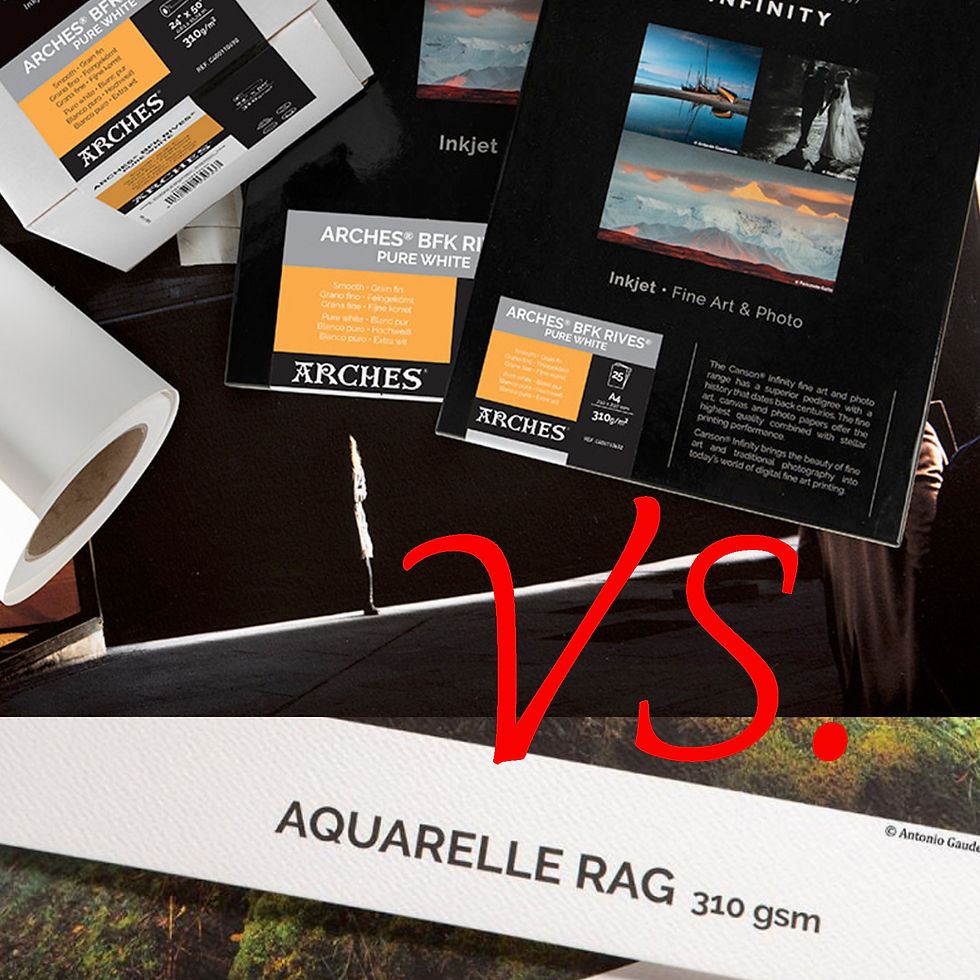
A quick look at both papers:
BFK Pure White
by Rives / Arjowiggins / Canson
Weight 310gsm
Surface Smooth matte
Base tone Bright white
Cotton content 100%
Texture Very slight tooth
Aquarelle Rag
by Canson Infinity
Weight 310 gsm
Surface Cold press texture
Base tone Natural white
Cotton content 100%
Pronounced texture
Surface feel and texture
This is the most immediately obvious difference between the two papers. BFK Pure White has a very smooth, almost silky surface with just a whisper of tooth to it. It feels refined and clean the kind of paper that puts the focus entirely on the image.
Aquarelle Rag is a different experience entirely. It has a genuine cold-press watercolor texture bumpy, tactile, and very much present. When you run your fingers across a print on Aquarelle, the paper is part of what you're feeling. That texture catches light in interesting ways, giving the print a handmade, almost painterly quality.
Quick tip: If your image contains large areas of flat color or very fine detail, the texture on Aquarelle can sometimes break up those areas in ways that look intentional on some images and distracting on others. When in doubt, request a test print.
How color and tone look on each
BFK Pure White's bright white base gives colors a clean, fresh lift. Blacks print deep and rich, highlights stay crisp, and the overall look is sharp and contemporary. It's particularly well-suited to photography, high-contrast work, and anything where color accuracy matters.
Aquarelle's natural white base is slightly warmer and more neutral. Colors tend to look a touch softer and more muted which sounds like a drawback but is often exactly right for certain types of work. Landscapes, fine art photography, botanical illustrations, and painterly images all tend to feel at home on Aquarelle. The texture also adds some sort dimension that smooth papers simply can't replicate.
What each paper is best for:
BFK Pure White
Photographic prints with fine detail
High-contrast black and white work
Contemporary or minimal artwork
Images with vibrant, saturated colors
Portraits and studio photography
Edition prints and artist multiples
Aquarelle Rag
Watercolor and painterly reproductions
Landscape and nature photography
Botanical or illustrative artwork
Warm-toned or film-style images
Work where texture adds to the story
Collectors' prints and gallery pieces
Weight and handling
Both papers feel substantial in the hand, but Aquarelle is noticeably heavier at 310 gsm versus BFK's 310 gsm. That extra weight contributes to the sense that you're holding something special. It also means Aquarelle tends to lay flatter over time, which matters if the print is going unframed or into a portfolio.
BFK at 310 gsm is no lightweight either it has a lovely rigidity that keeps it from feeling flimsy. For framed work, both are excellent. For handling and storage without a frame,
Aquarelle's extra heft gives it a slight edge in durability.
Longevity and archival quality
Both papers are museum quality archival stocks. They're 100% cotton rag (meaning no wood pulp and no acid that could yellow or degrade over time), both are buffered for alkaline stability, and both are designed to last well over 100 years under normal display conditions. Either choice is a responsible one if longevity matters to you or your clients.
So which one should you choose?
The honest answer is: it depends on the image and what you want the print to feel like. There's no universally better paper between the two only the better paper for a specific piece of work.
Think about the mood of your image. Is it crisp and graphic? BFK will likely serve it well. Is it soft, organic, and atmospheric? Aquarelle might feel like a natural home. And if you're ever genuinely unsure, ask us we look at images and papers together every day, and we're happy to give you an honest opinion before you commit to a full print run.
Both papers are available at DG Print Lab for fine art printing, and we print on them at $18 per square foot.


Comments